

The Global Mountain Explorer (GME) is a web-based tool that allows users to access and explore three geographic information systems (GIS)-based characterizations of mountains.
Although the answers to the questions 1) ‘what is a mountain? and 2) ‘where are the mountains of the world?’ might seem obvious and intuitive to many, there are surprisingly few attempts to rigorously and consistently define and map the mountains of the Earth. Three geographic information systems (GIS)-based characterizations, derived from global digital elevation models (DEMs) at a spatial resolution of approximately 1 km, considerably advanced our understanding of the global distribution of mountains. The first characterization is known as K1, developed by Kapos et al. (2000), and represents a resource produced by the UNEP World Conservation Monitoring Center (WCMC). The second, K2, was developed by Koerner et al. (2011) and is associated with the Global Mountain Biodiversity Assessment (GMBA). The third, K3, by Karagulle et al. (2017) was developed by Esri and the U.S. Geological Survey.
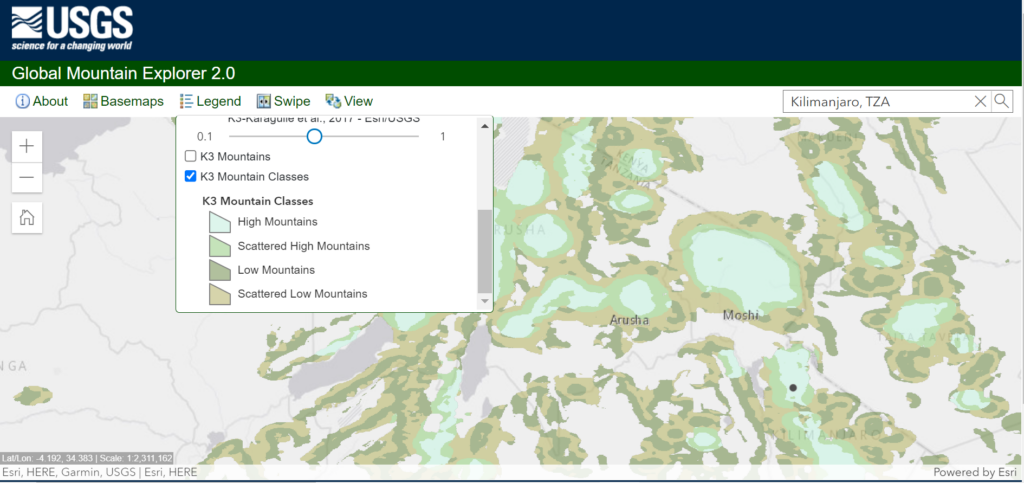
Despite the availability of well-developed and accessible documentation describing K1, K2, and K3, challenges remain in understanding how and where they differ. To facilitate access to and exploration of the three characterizations, the Global Mountain Explorer (GME) was developed. The GME is a map-centric web-based tool which allows users to query any location on Earth and identify whether or not it is mountainous according to these three characterizations. The map viewer has access to a wide range of functionality, including pan and zoom, making location queries split-screen pairwise comparisons, conducting text searches on place names, and displaying mountain areas over a variety of basemaps, including satellite imagery and topographic maps.
More information can be found in the following publication:
Sayre, R. et al. ‘A New High-Resolution Map of World Mountains and an Online Tool for Visualizing and Comparing Characterizations of Global Mountain Distributions,’ Mountain Research and Development, 38(3), 240-249, (2018): https://doi.org/10.1659/MRD-JOURNAL-D-17-00107.1
This resource is also available on the GEO Knowledge Hub: https://gkhub.earthobservations.org/records/cvhbz-3cb56.
The text for this page was provided by Roger Sayre from the U.S. Geological Survey.