

New research supported by a GEO Mountains Small Grant is helping scientists better understand how glaciers in Peru’s Cordillera Blanca are changing – and what this means for water resources, ecosystems, and climate resilience in the tropical Andes.
Peruvian glaciers play a vital role in mountain environments and for ecosystems and communities downstream. During dry periods, they can provide up to 40 percent of available water, while also serving as important indicators of climate change. However, they are retreating at an accelerated rate, highlighting the urgent need for continuous monitoring to better understand these changes and support adaptation efforts.
Monitoring glacier change is challenging, however. Traditional field-based methods require expensive and often risky expeditions to high-altitude sites, while existing indirect methods still lack the spatial and temporal detail needed to capture rapid changes in tropical glaciers.
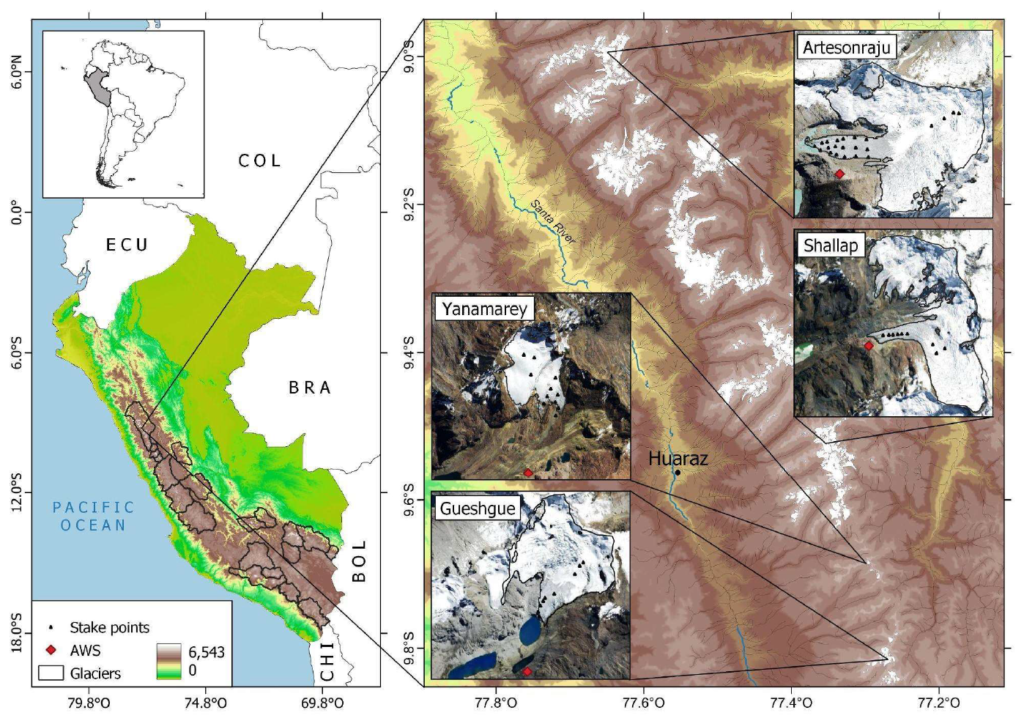
A new research project set out to help close this gap. With the support of a GEO Mountains Small Grant, an international team of researchers has been combining physical glacier models with artificial intelligence and diverse datasets to improve the monitoring of four glaciers in the Cordillera Blanca: Artesonraju, Shallap, Yanamarey and Gueshgue. Their work aims to produce more detailed, reliable data on glacier surface energy balance and surface mass balance – both of which are essential for tracking glacier health and change over time.
Blending Field Science With Artificial Intelligence
To improve hourly meteorological data from automatic weather stations (AWS) installed on glaciers in the Cordillera Blanca, the research team developed a novel machine learning approach. The AWS data was used to train a machine learning model (XGBoost) using key variables such as air temperature, relative humidity, wind speed, incident shortwave radiation, incident longwave radiation, surface pressure, and total precipitation, with ERA5 reanalysis data used as predictors.
These improved datasets were then used to feed an open-source COSIPY model, which simulates glacier surface energy and mass balance. The goal is to build a new, higher-resolution picture of how glaciers in the Cordillera Blanca are responding to climate pressures. This matters not only for glacier science, but also for future efforts to model water availability and environmental change in the region.
A Stark Warning From Yanamarey Glacier
One of the key outputs of this project is a paper published in Annals of Glaciology at the end of 2025. This paper presents a synthesis of recent glacier evolution in the Cordillera Blanca, based on glaciers that have been monitored with in situ measurements over recent decades. It draws particular attention to Yanamarey Glacier, one of the best-monitored glaciers in the Peruvian Andes and a reference glacier in the World Glacier Monitoring Service database. Since the 1970s, Yanamarey has shrunk sharply in area and length, and is now on the verge of vanishing. Its decline reflects a broader pattern of accelerating glacier mass loss in the Cordillera Blanca, one of the most glacierized tropical mountain regions in the world.
In addition to providing this important overview of glacier loss in the region, the paper highlights the dedication required to keep glacier monitoring going in such challenging conditions. Field teams work at high altitude and in hazardous terrain, facing steep slopes, crevasses, extreme weather, and tight budgets – all while trying to maintain long-term records that are vital for understanding change.
“Support from the GEO Mountains Small Grants programme was important in bridging a high-level collaboration between Universidad Científica del Sur, Autoridad Nacional del Agua, Instituto Nacional de Investigación en Glaciares y Ecosistemas de Montaña, the Federal University of Rio Grande, and the University of Grenoble Alpes,” explains project Principal Investigator Cinthya Bello, a lecturer at the Universidad Científica del Sur. “By combining field observations, physical modelling, and artificial intelligence, our multi-institutional team has advanced a critical line of research to better understand glacier retreat in the Cordillera Blanca. We are especially proud that this collective effort – which included the active participation of young researchers – has led to a published study on Yanamarey Glacier. This work not only highlights the urgency of glacier loss but also demonstrates the power of institutional synergy and sustained monitoring in addressing rapid environmental change in mountain regions.”
Strengthening Long-Term Glacier Monitoring
Beyond its scientific findings, the project contributes to something equally important: stronger collaboration and monitoring capacity.
The work connects with the international TROPIPOLAR-GLASCLIM project and supports a wider effort to integrate local field observations, remote sensing, and new modelling approaches across the Andes. The team has also presented related findings at international and regional events, and shared data through open platforms.
While some technical work continues, including the development of AI workflows and further model refinement, the project is already showing how small grants can help unlock innovation, support collaboration, and generate visible outputs.
Looking Ahead
As glaciers in Peru – and around the world – continue to retreat, improving how they are monitored and modelled will be increasingly important. Better data can support research, adaptation planning, and public awareness, while also helping institutions make informed decisions about water resources and mountain ecosystems.
This project offers a strong example of how targeted support can help researchers test new methods, strengthen partnerships, and contribute to a growing body of knowledge on glacier change in mountain regions.