

GEO Mountains is pleased to announce the release of Version 3 (v3.2) of its In Situ Inventory – a resource that seeks to make mountain monitoring efforts more visible, discoverable, and accessible to potential users and collaborators.
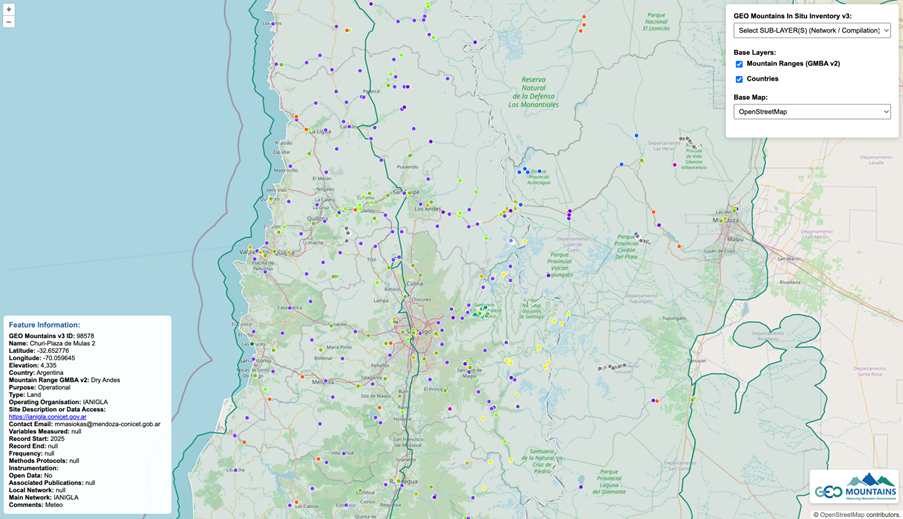
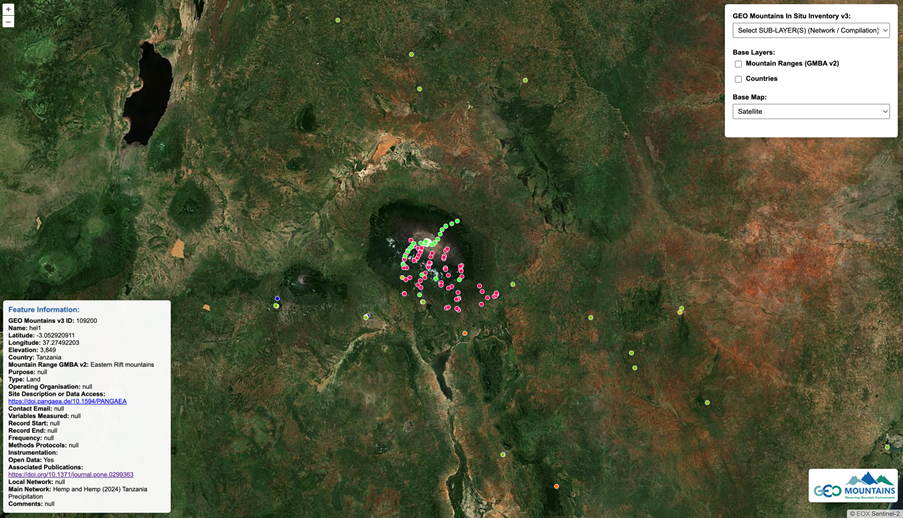
The Inventory is available as an interactive web map and in two alternative download formats.
What’s New in Version 3.2?
This latest update introduces three major developments:
- Expanded coverage – Many more stations and networks are now included.
- Network associations – Each station is associated explicitly with the wider network or compilation to which it belongs. Although this means that in some cases the same station appears in more than one network, this approach avoids the challenge of determining whether stations with similar coordinates across different lists represent the same or separate infrastructure.
- Mountain range attributed – Stations are now associated with the mountain range in which they are located, according to the GMBA Mountain Inventory v2. The extent of these ranges are also visible on the web map.
Why It Matters
Considering both ‘operational’ and ‘research-oriented’ stations, the total number of entries in the inventory is now well in excess of 100,000. Together with the growing trend for publishing the corresponding time-series via data descriptor articles (e.g. CAMELS, CA-Discharge, PatagoniaMet, EEAR-Clim) and elsewhere (e.g. SECoMet and Poleka Kasué), this suggests that mountains are better monitored than is often assumed, and somewhat challenges longstanding narrative of mountain regions being inherently data-poor. That said, significant challenges in sustaining long-term monitoring, data accessibility, data sharing, and overall data governance remain.
Future Possibilities
Looking ahead, if the Inventory could be made even more comprehensive, particularly with regard to metadata, it could support powerful “data coverage” analyses across space, time, elevation, and discipline. Such analyses would not only highlight data gaps but could also help make the case for increased investment in mountain observation, improved data management, and greater sharing of resources.
Plans are underway for a next release in 2026-2027, with additional metadata and updates as they become known. For any enquiries, please contact us at the GEO Mountains Secretariat: geomountains@mountainresearchinitiative.org