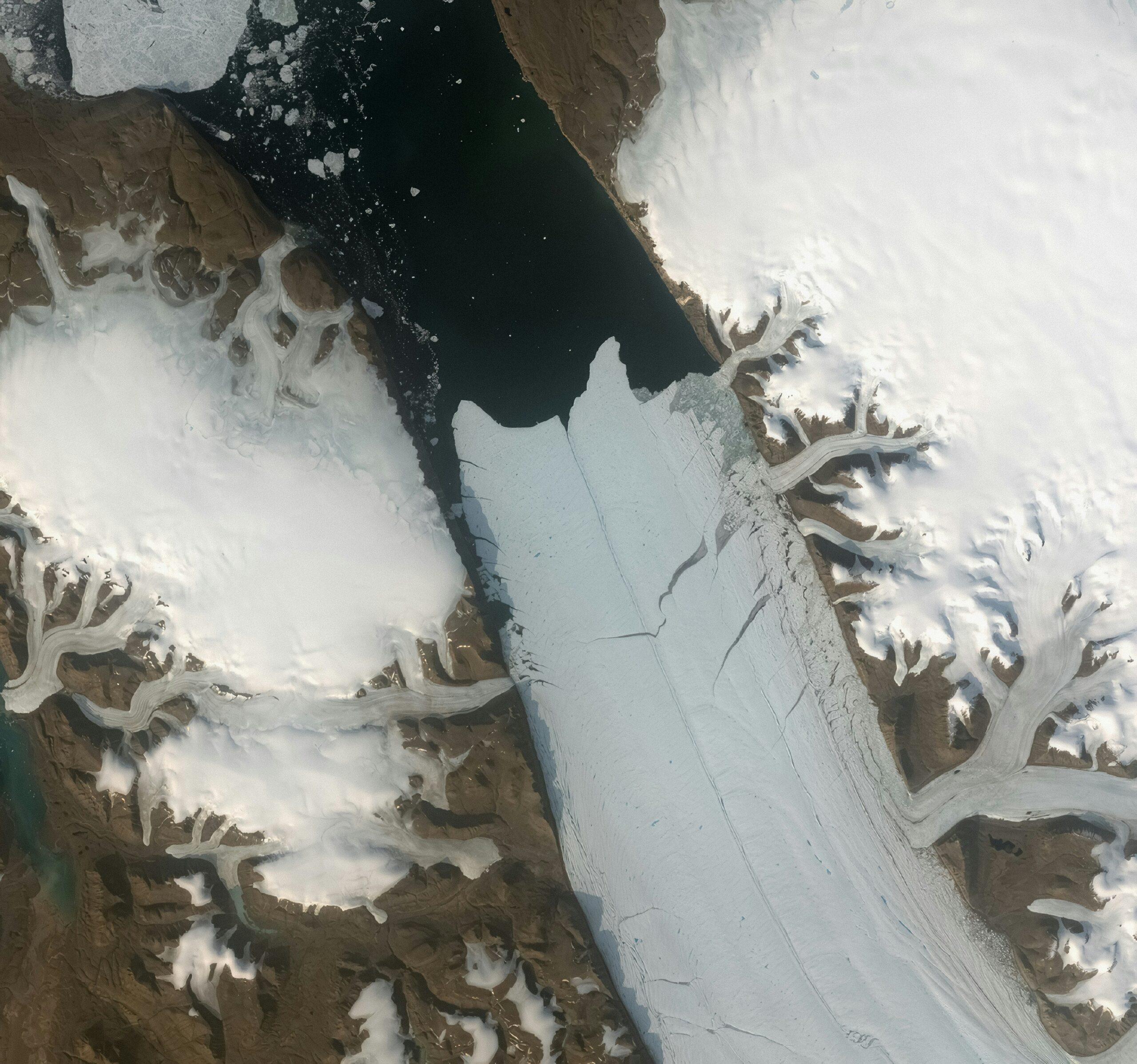
Dataset Update: MEaSUREs Greenland Ice Mapping Project (GIMP) Land Ice and Ocean Classification Mask, Version 1
The MEaSUREs Greenland Ice Mapping Project (GIMP) Land Ice and Ocean Classification Mask, Version 1 dataset, available at the NASA…


The MEaSUREs Greenland Ice Mapping Project (GIMP) Land Ice and Ocean Classification Mask, Version 1 dataset, available at the NASA…

Four exciting regional GEO events, at which the GEO community will continue to drive the mission of delivering Earth Intelligence…

The GEO Mountains General Meeting 2021 served as a platform for exchange, bringing participants up to speed on recent developments at GEO Mountains and inviting discussion on the activities of Task Groups. GEO Mountains participants also provided key updates on ongoing projects that could contribute to the objectives of GEO Mountains.

GEO Week 2021 was held 22-26 November, and highlighted the many activities of the GEO work programme that address this year's major milestones linked to global policy agendas, such as the 26th Conference of the Parties (COP26) to the United Nations Framework Convention on Climate Change.
On Thursday 25 November, GEO Week 2021 focused on the use of Earth observations data to bridge the digital divide. As a part of this, GEO members presented examples of projects and initiatives being undertaken worldwide in order to facilitate full and open access to Earth observation data, thereby promoting policy development and supporting informed decision-making. Among the initiatives participating was GEO Mountains, represented by James Thornton, GEO Mountains Scientific Project Officer, and Carolina Adler, Executive Director of the Mountain Research Initiative and GEO Mountains Co-Lead.

Taking place as part of the COP26 Geneva Cryosphere Hub on 3 November, the focus of this session was on the potential offered by Earth Observation (EO) technology to observe, monitor, and assess the Earth’s Cryosphere.
The event kicked off with GEO Mountains Scientific Project Officer Dr. James Thornton presenting the work GEO Mountains is undertaking to enhance the discoverability and accessibility of existing mountain data and information – both in situ and remotely sensed – across global mountain regions. He also introduced the concept of Essential Mountain Climate Variables (EMCVs) to support the monitoring and understanding of key climate change-related mountain processes.

The General Assembly 2022 of the European Geosciences Union (EGU) will be held at the Austria Center Vienna in Vienna, Austria, from 3–8 April 2022. This event includes a number of exciting, mountain-related sessions, including one convened by representatives of GEO Mountains. Abstract submission closes 12 January 2022.
The EGU General Assembly 2022 brings together geoscientists from all over the world to one meeting covering all disciplines of the Earth, planetary, and space sciences. The EGU aims to provide a forum where scientists can present their work and discuss their ideas with experts in all fields of geoscience.

We are looking for the brightest stars in the Group on Earth Observations (GEO) constellation for the 2021 GEO Individual Excellence Awards.
Launched in 2019 by the GEO Programme Board, this award is presented annually to individuals in the GEO community who have demonstrated remarkable personal commitment to the GEO mission and vision. With this award, we want to celebrate those individuals whose work is making a positive impact in improving our planet through Earth observations (EO).
Nominations submission deadline 15 October 2021.

The African Research Fellowship (ARF) coordinated by European Space Agency (ESA) aims at empowering African Researchers (PhD or Master degree with extensive research experience) to carry out Earth Observation (EO) R&D activities relevant for the EO AFRICA Initiative.
The African Research Fellows shall maximise the use of EO data in synergy with in-situ and state-of-the-art modelling approaches, in a cloud environment, to respond to the challenges the African continent is facing with respect to: water resources management and food security.
With this call, ESA offers 1-year fellowships to work at the ESA-ESRIN premises in Frascati (Rome, Italy).
Submission deadline 30 September 2021.

The European Space Agency (ESA) and Future Earth have partnered to facilitate the development and uptake of Earth observation data by Future Earth’s research networks.
There is seed funding to support research activities on the use of satellite data to provide empirical evidence of environmental and ecosystem change, and the risk these pose to society. Proposals are particularly welcomed on the themes of biodiversity, climate impacts on human health, or climate tipping elements, to better understand feedbacks, interactions and instabilities, but note that the call is not exclusive to these themes. This is an open call to the Global Research Networks (GRPs and KANs) of the Future Earth community. The activities should address pressing research questions that are a priority for the networks.
Submission deadline 30 September 2021.

New research based on information from the European Space Agency’s CryoSat mission shows how much ice has been lost from mountain glaciers in the Gulf of Alaska and in High Mountain Asia since 2010.
As our climate warms, ice melting from glaciers around the world is one of main causes of sea-level rise. As well as being a major contributor to this worrying trend, the loss of glacier ice also poses a direct threat to hundreds of millions of people relying on glacier runoff for drinking water and irrigation.